
Year: 2016
Crowdsourced Translation: Does it Work?

The World Wide Web has made it possible to communicate at all times, across all boundaries and on an unimaginable scale. The communication revolution lies at the root of trends that are changing how we go about our daily lives such as the sharing economy and crowdsourcing, crowdfunding, etc. But can crowdsourced translations prove as effective as traditional methods of translation?
The Origins of Crowdsourcing
Crowdsourcing is based on the premise that collaboration taps into a collective wisdom that is greater than the sum of its individual parts. As early as 2004 James Surowiecki eloquently argued that a diverse collection of independently deciding individuals with access to aggregated information will reach better decisions and predictions than could have been made by any single member of the group in his seminal book, The Wisdom of Crowds: Why the Many Are Smarter Than the Few and How Collective Wisdom Shapes Business, Economies, Societies and Nations.
According to Crowdsourcing Week, “…crowdsourcing is the practice of engaging a ‘crowd’ or group for a common goal…Thanks to our growing connectivity, it is now easier than ever for individuals to collectively contribute — whether with ideas, time, expertise, or funds — to a project or cause…”
Crowdsourced Translation for Social Media Content
In general, crowdsourced translation falls into two main categories: translation by a “true” crowd, i.e., non-professional translators (such as Google Translate users correcting automatic translations) and translations by a “crowd” of professional translators working on crowdsourced translation service platforms such as TM-Town, Gengo, Smartling and others.[3]
The rise of social networks has created both a need and a platform for real-time translation of user-generated content in order to support communication on a global scale.
An interesting example of mobilizing a “true” crowd for social media translation is Facebook’s very recent introduction of a new feature that helps people post Facebook updates in multiple languages. The user can either write the translations from scratch or edit text that Facebook’s translation software generates from the original post. With more than one billion people using Facebook every day, this crowdsourced translation feature will provide Facebook with valuable new data to improve the ability of its translation software to convert slang and other informal language from one language to another (the holy grail of machine translation!)[1].
An example of mobilizing a crowd of translators to provide real-time translation of social media posts on a massive scale is Stepes’ recent launch of its Twitter translation API, which leverages the company’s mobile translation platform to translate and repost translated tweets to designated accounts. Customers sign up for the translation service via their Twitter accounts. The API extracts the tweets to be translated and sends them to Stepes’ network of ~50,000 translators who translate-on-demand anywhere and anytime from their smartphones. The cost to translate is ~10 cents per word and customers can set daily spending limits.[2]
Does Crowdsourced Translation Capture Collective Wisdom?
On the one hand, crowdsourced translation – whether by non-professionals or professionals – is quick, scalable and relatively inexpensive. But in the case of crowdsourced translation by non-professionals, who’s to say that their translations are good or that they won’t abuse the platform to teach the system false translations? Thus, for example, Facebook itself has announced that it doesn’t automatically start using new translations picked up from user data. It relies on professional translators to verify that the crowdsourced translations are correct. [1] There is little doubt that crowdsourced translations are far more vulnerable to mistakes and mistranslations than professional translation, and could prove risky if used in a professional or business setting. [3] On the other hand, a hybrid process like the one implemented by Facebook where professional translators oversee the crowdsourcing process and verify that the resulting translations are accurate could prove effective.
So does crowdsourced translation work? The truth lies somewhere in the middle. Indiscriminate, uncontrolled crowdsourced translation is unlikely to produce quality translations in a reliable and consistent manner. But platforms that encourage professional translators to share knowledge and collaborate can most certainly create collective wisdom that will drive professional translation to ever higher levels. And crowdsourced translations working in tandem with professional translators can potentially provide decent quality faster and at a lower cost that professional translation alone.
References
[1] Tim Simonite, New Translation Tool Will Help Facebook Master International Slang, MIT Technology Review, July 1, 2016
[2] Eileen Brown, Stepes uses human translation around the clock to translate Tweets, ZDNet, June 14, 2016
[3] Pieter Beens, The dangers of crowdsourcing translations, June 15, 2016
Get the latest insights delivered to your inbox
7 Tips to Ensure High-Quality Legal Translation

Legal document translation is a specialized discipline that requires mastery of both the source and target languages, and an in-depth understanding of the relevant legal terminology. It helps to be familiar with the subject matter/practice area as well as the legal system where the translation will be submitted. Clear communication with your translation company, including any details you can provide about the case and how and where the translation will be used, will help ensure that the legal translation you receive is highly accurate and relevant to your needs.
Here are 7 tips to keep in mind when briefing your legal translator, to ensure the outcome meets your expectations:
- Be clear about what needs translating
Legal documents can be lengthy and may include information that doesn’t require translation. Cover pages, signature pages, address information and handwritten notes on the margins may or may not need to be translated. To save money, be clear on which sections of the document actually need to be translated.
- Talk to your translation company about how the document will be used
Some document translations are needed for information purposes only. In other cases, the translations will be submitted in court and must be certified. Knowing what the translation is for and who the audience is will help ensure that its quality and cost meets your expectations.
- Agree on a glossary of key terms
When a legal term in English has more than one foreign language equivalent, you may want to designate the foreign language term you prefer so that it is used consistently throughout the document (and throughout every document related to your specific legal latter). Getting this done at the start of the translation process will help to reduce scope for error further down the line.
- Double-check the dialect
Just as there are variations in spelling and style across Anglophone countries, the same is true for other languages. In some cases, like Chinese, Spanish and Portuguese, the differences are quite significant and potentially of critical importance in a legal content. Translating a document into Spanish for Mexico? Make sure your translator is aware of this and understands the difference between Latin American Spanish and European Spanish.
- Understand the legal system
Understanding the target country’s legal system is an often overlooked but critical aspect of legal document translation, especially if the documents in question relate to complex litigation. Each country’s legal system includes culturally-dependent concepts that are reflected in the legal language included in contracts, agreements, etc. In particular, legal documents that are translated for court must use the precise legal terminology employed in that country.
- Be clear about how you would like the document to be formatted
In general, legal documents are either presented in a bilingual format, where the original text and the translated version are side-by-side, or in a monolingual format, which is separate but follows the same format as the original document. Depending on how the translated document will be used, you may prefer one format or the other. If the document includes tables, graphs, or images, make sure to specify if you would like “mirror-image” formatting that looks exactly like the original document, or if just translating the text will suffice. Keep in mind that recreating the tables and images with the translated text will likely incur some formatting/DTP fees.
- Keep your translator in the loop
Deadlines can quickly change, especially during litigation. Court dates are pushed up, additional documents are unearthed during discovery, and suddenly that legal document translation that was due next week needs to be reviewed tomorrow. Keeping your translator in the loop about your changing needs and timeframes will help ensure that they provide the best possible legal translation.
Get the latest insights delivered to your inbox
Machine Translation and Multilingual E-Discovery

E-discovery hit prime time in the November 2015 episode of The Good Wife, appropriately entitled “Discovery”. Chumhum, a large search company, is being sued by a restaurant owner because one of its applications, Chummy Maps, has designated the restaurant’s neighborhood as potentially unsafe and hence put her out of business. The key accusation is that the safety level algorithm is based on racial demographic profiling. Fans of the mega-popular series got a peek behind the scenes of how digital forensic methods are used to extract potentially relevant evidence from terabytes of electronically stored information (ESI).
E-discovery was born in 1970 when the US Federal Rules of Civil Procedure (FRCP) were amended for the first time to make “data compilations” discoverable. If in the subsequent decade there were less than 10 e-discovery cases, in the half-decade between 2010 and 2015 there were more than 360 such cases tried before the courts in the US.[1] Examples of the types of ESI included in e-discovery are e-mails, instant messaging chats, documents, accounting databases, CAD/CAM files, and Web sites.[2]
Now take the breathtaking scope of e-discovery in and of itself and put it in the context of a lawsuit that is being conducted across borders, including countries where the ESI is not in English. Given economic globalization, multilingual litigation is no longer rare and, according to Gartner, by 2020 80% of all litigation will be multilingual.
One of the ways to manage the daunting costs and time frames of multilingual e-discovery is to use Machine Translation (MT). However there is an ongoing debate as to whether MT is good enough to ensure a reliable e-discovery process. Despite the advances in MT since its commercial debut in the 1980s, there are those who argue that MT is still too literal. Nuanced meanings in the original are lost and grammatical errors are introduced into the finished product. Specifically in the case of e-discovery, there are concerns that MT does not account for differences in legal terminology and systems across cultures. Last but not least, submitting legal documents to online machine translation systems could very well constitute a breach of confidentiality.[3]
No machine learning technology can replace the distinctly human ability to understand context and bridge cultural gaps. Here are some ideas how both human translation and MT can be used in multilingual e-discovery to effectively address both quality and cost constraints:
- MT can be effective when formal or formulaic language is used such as, for example, in legal or scientific documents.[4]
- MT can be used to give a “gist translation” that is good enough for the English speaking review team to categorize documents and get a certified human translation of the subset of documents that are most relevant.[5]
- Highly customized MT engines can be used, supported by a post-editing process involving legal translation experts.
References
[1] 10 Things You Didn’t Know About E-Discovery [infographic]
[2] AIMM – What is e-Discovery?
[3] The Importance of Human Translators for Legal Translation Projects, March 30, 2015, Merrill Corp.
[4] Multilingual Ediscovery: Options, Obstacles and Opportunities Report, Kroll Ontrack
[5] The World Is Flat: Handling Foreign Language Documents In E-Discovery Projects
Get the latest insights delivered to your inbox
5 Tips for Translating Technical Manuals

A technical or user manual provides critical information on using your product to consumers. If your consumers are non-native English speakers, then it is equally important to translate your technical manual into your end-users’ native tongue. Whether it’s user instructions for the latest smartphone, a maintenance manual for a complicated piece of machinery, or a user guide for new software, having an accurately translated technical manual will help clients make the most of the product or service and ensure their correct use of the product. It also helps limit your liability in the event that the product is used incorrectly, saves time for your customer support team and acts as a springboard for sales. Translating your technical manual may even be required by foreign regulatory bodies in order to sell your product in their jurisdictions.
But translating a technical manual is no easy task. Technical manuals tend to contain a lot of jargon, and if the product or service is newly developed, it may even contain vocabulary that has no direct equivalent in the target language. A literal translation simply won’t cut it when it comes to translating technical manuals. In addition to having a thorough grasp of the concepts involved, the technical translator needs to be able to correctly translate those concepts into the target language and be familiar with the relevant terminology in the target language.
If your technical manual requires translation, here are 5 tips to ensure that you get a technical manual translation that meets your needs:
- Look at what’s been done before
If your company has translated technical manuals in the past into the same language, you may have translation memory or a glossary in place that can be re-used, helping lower costs and saving time on your next project. If you have preferred terminology for specific languages, be sure to let your translation company know so that they can incorporate it. Finally, it’s helpful to review the fully designed version to get an idea of the look and feel of the end result. If you’ve produced similar documents in the past, you may want to maintain the same design to meet customer expectations.
- Agree on a glossary
If there are key words and terminology that you use throughout your manual, it’s important to translate them as accurately as possible and consistently throughout your manual. Again, if your company has translated manuals in the past, it makes sense to share those translations with your translator. This will help ensure that the language used to describe your product or service is consistent and meets the expectations of your customers.
- Keep it simple
Writing technical manuals is complicated enough and correctly translating technical terminology is already a challenge. You may be tempted to add a joke, word-play or culturally-specific reference to lighten things up, but it’s usually best to keep things simple. Humor doesn’t always translate well and can sound jarring in a foreign language. Review your manual to see if there is anything too culturally specific that might not transcend the language barrier. If you’re not sure, your translation company will be able to provide more guidance.
- Watch the length
Technical manuals tend to be quite long. This can’t always be helped and it’s hard to keep it brief when you are explaining a complicated process. But keep in mind that translators usually charge per word (sometimes per page) and that the longer your technical manual, the more it will cost to get it translated. Also, when translating from English into Romance Languages (French, Italian, Spanish, etc.) text tends to expand, so your manual will end up even longer. If your manual needs to stay within a certain number of words, make sure the format gives you some space to play with.
- Ask for feedback
The whole point of having a user manual translated is to make your product is accessible and easy for your customer to use. Your customers will be able to tell you just how useful your translated manual is and are invaluable source of feedback. If you’ve already published manuals in another language, ask the clients who’ve used them if they have any suggestions. If this is your first time translating a technical manual, make sure to follow up by asking a few questions and note any recommendations for the future.
Get the latest insights delivered to your inbox
The Language of Science: Scientific Communication

English is undoubtedly the primary language of modern scientific communication of international science, with an estimated 98% of all scientific publications being written in the language. The linguistic command of English is also seen in scientific journalism worldwide, depending strictly on English sources. Using a single international language for science facilitates the circulation of scientific knowledge across national and even cultural boundaries. But it hasn’t always been that way.
Scientific Communication: The Early Lingua Franca
Before the 17th century, scientific publications were primarily written in Latin. For example, in 1687, Sir Isaac Newton wrote his book Philosophiæ Naturalis Principia Mathematica, which explained his laws of motion and gravity in the Latin language. At the time, education wasn’t accessible to most of the population, so Latin was the language of the elite and intellectual classes. Even the name ‘gravity’ reflects this, coming from the Latin word ‘gravitas,’ which means heavy.
Gradually, more scientists began publishing their works in the vernacular to make their ideas accessible to the masses, and Latin lost its status as the scientific lingua franca. But since the primary reason for publishing scientific research was to share ideas and knowledge, there was concern that publishing scientific papers in so many different languages would hinder scientific communication and the understanding of necessary research being conducted abroad. Although English in our modern era has gained dominance over scientific publications, it does not mean that each native language is not defended, as required in the language of the scientist’s community. By the mid-19th century, three primary languages were used to promote scientific thought: English, French and German.
However, a publication available in only one language can be understood by the academic community with sufficient language skills in the published language. Professional scientists were expected to be proficient in all three languages and publish exclusively in those languages. By 1900, the dominant language of science was German. Thanks to leading scientists like Einstein, Planck, Heisenberg and others, it remained that way until World War I led to boycotts of German scientists who were often barred from publishing in Western European journals.
English Takes Over as The Language of Science
Conflicts throughout the 21st century, including both World Wars and the Cold War, transformed the way scientists around the world communicated with each other. By the mid-1990s, English had firmly established itself as the language of science. Nowadays, anyone who wants to share their ideas must publish their work in English.
In many countries, college-level science education is now conducted in English—partially because studying science in English is good preparation for a future scientific career and partly because the necessary words often don’t exist in any other language. Many scientific textbooks are written in English for students in non-English speaking countries. These students are required to have proficient English to pursue degrees and, eventually, careers in the sciences.
This poses problems for scientists and students who do not speak English as their first language. Considering that just 15% of the world’s population speaks English, with just 5% speaking English as their mother tongue, the fact that the latest scientific discoveries are primarily written about in English can make the whole profession seem inaccessible.
It’s difficult enough to read a scientific paper in a foreign language, but the requirement to write a scientific essay in English can seem an impossible task when it’s not your mother tongue. It involves explaining complex theories and using nuanced language to ensure the reader thoroughly understands the concept, which requires another skillset entirely.
The fact that English has become the language of science isn’t likely to change any time soon. But how can scientific papers be made more accessible to those who speak English as a second language? Can we optimize communication and level the playing field to ensure scientists around the world can be heard?
Improving Multilingualism in Scientific Communication
Publications that are available in two or more languages can be read and understood by more people and contribute to improved dissemination of scientific knowledge, providing added value to society as a whole.
Scientific journals have an opportunity to translate research abstracts and articles to make them available in languages other than English. Some journals offer abstracts translated into other languages, while English remains to gatekeep a portion of the scientific community and general public from the research. Enlisting a language services provider (LSP) can produce a high-quality translation to even the scientific playing field.
Morningside has provided leading pharma, biotech and medical device companies with reliable language solutions for over 20 years. Our expertise covers the spectrum of therapeutic and technical proficiencies, and our linguists are rigorously vetted to ensure end-user comprehension and preservation of intended meanings, whatever the subject matter.
By employing industry-leading technologies – some of which are proprietary, we decrease turnaround time, control costs, and enhance the quality of your translations. Translation Memory ™ tools, client-specific glossaries, and our proprietary Quality Reliability Indicator (QRI) are some of the intelligent, secure, ISO 27001-backed technologies we utilize to mitigate risk and ensure consistent reliable translations.
About Morningside
Morningside, a Questel Company, equips the world’s leading life sciences organizations with a full suite of end-to-end language solutions for their regulatory, clinical, commercial and patent needs. With over 4,000 clients in 55 countries, we’re globally recognized for our life science expertise and technology innovation across pharma, biotech, medical devices, and healthcare. Our life sciences translation services ensure your products and ideas seamlessly reach new markets and comply with all regulatory and cultural requirements through every stage of the product lifecycle — from patent to post-market.
Working exclusively with qualified subject matter experts (SMEs) is part of our unwavering commitment to quality. Morningside employs ISO 9001, 13485, and 17100-compliant processes and controls and a 3-tier linguistic review process. As an added step to mitigate risk, our proprietary algorithm, the Quality Reliability Indicator (QRI), monitors projects, preemptively identifies areas of potential risk and prevents quality issues before they happen to ensure a reliable and repeatable outcome.

Anna Eisenberg is an Associate Director of Life Science Business Development at Morningside, with 20+ years of experience in the localization industry and a focus on life sciences. She is responsible for Morningside's life science strategy and maintaining relationships with global leaders in the field. Anna expertly advises pharmaceutical and medical device companies on best translation practices and is an expert in implementing workflows that improve quality, reduce costs, and accelerate deadlines.
Get the latest insights delivered to your inbox
Morningside’s Japanese Translation Services
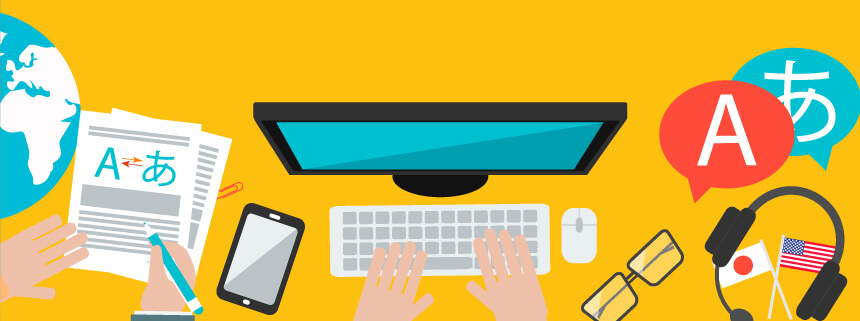
At Morningside, we translate a vast range of documents and texts into over 100 languages, and have worked with clients around the world to help them successfully reach out to new consumers and do business in the global marketplace. While Morningside has years of experience in multiple languages, one language which we are particularly experienced in and translate frequently is Japanese.
Japan is one of the world’s major economic powers, despite its small size, and is a significant manufacturing hub for many industries, including automobiles, electronics and pharmaceuticals. We work with many Fortune 500 companies, government bodies, regulatory agencies and law firms all over the world who require professional translation of documents and patents both from and into Japanese. With such high demand for Japanese translations, we have a highly-skilled team of Japanese translators on hand with an impressive knowledge of Japanese technical terminology, language and culture.
Key Practice Areas for Japanese Translation
Many of the companies we work with require translation of documents to manufacture consumer products, technical products or pharmaceuticals. In addition, our Japanese translations are frequently used for litigation purposes. For this reason, legal, patent, medical and business translation are our most important practice areas, and we have talented, experienced linguists on hand to handle each area. Our in-country translators are all fully certified with proven experience in their subject matter. This provides our clients with the peace of mind knowing that their documents and patents are accurately and professionally translated in accordance with local language, technical terms, legal guidelines and regulatory standards.
Although manufacturing, pharmaceuticals and technology are three of the major industries for which we provide Japanese translation services, we also cater to the following industries:
- Legal
- Finance
- Consumer products
- Human resources
- Energy
- Media
- Government
- Life sciences
When it comes to technical subjects such as engineering, medicine or pharmaceuticals, documents are always reviewed by qualified translators with an educational background in the relevant field. We set the highest standards in the industry when it comes to hiring and vetting translators.
Fast Translations for Fast-Moving Industries
Things happen quickly in big corporations, and even more so during litigation, so we know how important it is to work quickly and efficiently while still ensuring the highest level of quality. We often perform rush jobs for clients in need of Japanese translations, and can reliably maintain our high standards even on the tightest of deadlines. Our schedule runs around the clock, 24 hours a day, 7 days a week, so we are always available to deal with inquiries and get started on urgent translations.
Japan is one of the most important and innovative markets in the world, and with our professional translation services at hand we’re helping hundreds of clients to successfully become a part of it.
Get the latest insights delivered to your inbox
Welcome to the World of Neural Machine Translation

Decades of well-funded machine learning and artificial intelligence R&D is starting to make its mark on the world of machine translation. Over the last few months there have been several important announcements from the likes of Google, Facebook, and Microsoft about their initiatives in applying artificial intelligence (AI) technologies to translation. For example:
- On April 28 Google’s US patent application “Neural Machine Translation Systems With Rare Word Processing” was published. Google is claiming exclusive rights to an NMT system made specific by how the system is implemented.[1]
- Facebook, which serves up two billion translations each day,[3] has begun the transition away from the Bing translation system to a new neural network system to be fully deployed by the end of this year[2].
- In February Microsoft revealed that they are leveraging AI―including deep learning―for their own Translator Hub.[4]
So what is Neural Machine Translation?!
Current phrase-based machine translation systems consist of many subcomponents that are optimized separately. Neural machine translation is a novel approach in which a single, large neural network is trained, maximizing translation performance.[5] In the Google patent application mentioned above a neural MT system is defined as “one that includes any neural network that maps a source natural language sentence in one natural language to a target sentence in a different natural language.”
Neural networks are a deep learning technology that simulates the densely interconnected network of neuron brain cells that allow us to learn, recognize patterns, solve problems and make decisions.
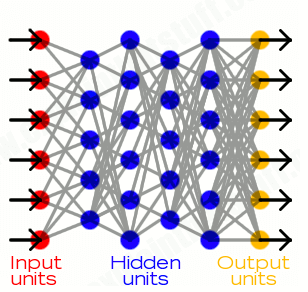
A fully connected artificial neural network is made up of input units (red), hidden units (blue), and output units (yellow), with all the units connected to all the units in the layers either side. Each connection is assigned a “weight”, which indicates the strength of
the connection between the units.
Inputs, which are fed in from the left, activate the most relevant hidden units in the middle, which then activate the appropriate output units to the right.
Neural networks are trained by comparing the output produced with the output it was meant to produce, and using the difference between them to modify the weights of the connections between the units in the network.[6]
Neural Machine Translation systems are far more complex and adaptive than statistically trained models. Once trained, a translation neural network has contextual awareness and deep learning capabilities that allow it to understand the domain in which a conversation is taking place and the linguistic norms of that environment.[2]
The Promise of NMT
NMT is still in its infancy and transforming it into a truly robust platform will be a highly collaborative effort. Google may end up holding a seminal patent but as Language Weaver co-Founder Marcu notes, “There are hundreds of statistical-MT-related patents. Getting statistical MT to work required hundreds of innovations. Neural MT is no different. It will require hundreds of innovations and patents to get MT to the next level of accuracy.”[1]
To this end, it is encouraging to note that last year Facebook open-sourced Torch, its deep learning library, and, later in the year, it open-sourced its AI server Big Sur. In November, Google opened its TensorFlow machine learning library for public use. Amazon released its deep learning software DSSTNE last month.[8]
In addition, watch out for hardware advances that will further enhance the performance of neural networks in general, and NMT in particular. At the end of May the startup company Nervana announced that, in cooperation with Google, it is designing and building a custom ASIC processor for neural networks and machine learning applications that will run 10 times faster than the graphic processor units (GPU) that are typically used today for neural network computations.
As NMT takes machine translation to the next level, human translators will have a powerful partner in the quest to achieve and maintain the highest levels of quality in the face of ever-growing quantities of content to be translated.
References
[1] Marion Marking, Google Applies for Neural Machine Translation Patent, Experts React, May 24, 2016
[2] Peter Corless, Facebook, Google and the Future of Neural MT, June 2016
[3] Rachel Metz, Facebook Plans to Boost Its Translations Using Neural networks This Year, May 23, 2016
[4] Gino Dino, Confirmed: Deep Learning Is Coming to Google Translate, March 17, 2016
[5] Neural Machine Translation by LISA, University of Montreal, 2014
[6] Chris Woodford, Neural networks, March 18, 2016
[7] Steven Max Patterson, Startup Nervana joins Google in building hardware tailored for neural networks, May 31, 2016
[8] Khari Johnson, Facebook wants chatbots to learn the way people do, June 16, 2016
Get the latest insights delivered to your inbox
Translation Beginners Guide to Documentation Services
For companies and organizations planning on expanding into new territories, here is a translation beginners guide to the world of document translation. In order to build a professional reputation, high quality and accurate translation is key across all documentation. Before contacting a translation service for a quote, it’s important to figure out exactly what you’ll need from them, so ask yourself the following three questions:
1. What type of documents do you have?
Are you a business planning to expand into a new region? Or are you an engineering firm that requires the translation of technical documents for a different country? In order to find a translation company that is best suited to your needs, you should know what type of documents you have; are they legal, business, patent, medical or technical? With this in mind, you can approach skilled translators that have specific experience in the field most relevant to your documents and the quality of translations you require.
2. Which countries and languages will you be translating into?
Translating isn’t always as simple as rewriting text into a new language; you need to consider the culture of your new audience too, and should take into account industry-specific technical terms, local dialect and even the formatting and style that meets expectations for such documents in your target country. When you approach translation companies, be sure to clarify both country and language to ensure that your documents are translated to a high standard for your target audience.
3. Who do you want to work with?
There is a wide-range of translation providers out there, each with their own pros and cons:
Translation Company
The biggest upside of working with translation companies is that they can usually handle large amounts of documents at one time and with short turnaround time, since they often have a large pool of translators they can call upon. Plus, their translation teams will likely be made up of a range of vetted translators with different areas of expertise so you can be confident that each document is handled by the most suitable translator. Another benefit of using a translation company is that the translated documents usually go through several stages of editing, proofreading and quality control to minimize the likelihood of errors. But not all translation companies are the same, and like so many things in life, you get what you pay for, so make sure that the translation companies you are considering for a specific project include proofing in their fees.
Freelance Translator
Working with a freelancer is a great way to build up a long-term and reliable relationship and cut out the middle-man, but the downside is that they may not be able to handle bulk quantities of work and most likely can only handle 1-2 language combinations. If you’re well organized and can work with long lead-times, this may not be a problem, but for busy companies that require a fast turnaround, a freelancer may not be the best solution. In addition, it may prove to be difficult to determine the quality and skill sets of a freelancer, which can vary considerably.
Bilingual Staff
Hiring permanent bilingual staff is a great solution for companies that want to keep document translation in-house, as there will always be a translator on hand for moments where deadlines are tight. For companies that work in just one or two foreign countries and regularly translate documents into just those languages, in-house translators are incredibly useful and may also be the best option in terms of cost. However, for companies which require translations for several countries, or only need translators on an ad-hoc basis, it can become expensive and cumbersome to hire permanent staff to handle all languages required.
Machine Translation
Although the likes of Google Translate can be useful for basic translations or getting the gist of a document, when it comes to official documents, business documents, marketing documents etc. they are simply not sophisticated enough (yet) to accurately translate your materials and often produce gibberish. Machine translation tools can be helpful, providing that you have a native speaker read over the translation afterwards to check for errors, but they will not provide the professional results that an experienced human translator can.
Get the latest insights delivered to your inbox
Meet Morningside @ DIA 2016!
Morningside is excited to sponsor the DIA 2016 Annual Meeting in Pennsylvania. The conference kicked off on Sunday and will continue through Thursday July 30th. As a leading life sciences translation provider, Morningside offers a full suite of medical translation services for clinical trials, regulatory compliance, e-learning, medical device and pharmaceutical translation. If you are attending, make sure to stop by Booth #2244 to grab some fun giveaways and learn more about us!
We look forward to seeing you there!
Get the latest insights delivered to your inbox
Best Practices for Localizing Apps
App localization is a fantastic way for developers to dramatically expand their audience base, but for the uninitiated the thought of translating and localizing an app can be a little daunting. Here are five of the most important best practices to adhere to when starting the localization process.
1. Think international at all stages of development
You may only be developing the app for the US market now, but if expansion to new territories is on the cards for the future, you’ll need to prepare for localization from the very start of your app development process and always have ‘international’ on your mind. For example, you’ll want to set up code that can easily update country-specific elements such as time, dates, currencies and even telephone and address formats. By considering all of these elements early on, you’ll be able to save huge amounts of time when rolling out localized versions.
2. Work with a tech-savvy, local translator
When it comes to apps, where text snippets tend to be short and sweet and users expect clarity and simplicity, it’s often impractical to simply translate text word for word. Instead, your translator will need to find the most appropriate phrases that are relevant and understandable in the target market. In order to do this, they must have a good understanding of how your app works and how it will fit in culturally with the target country. They must be tech-savvy, as well as skilled in linguistics.
3. Don’t hard code translatable content
If you hard code every single piece of text in your app, you’ll have to make major rewrites with each new target country as you switch out translated text, and your translator may have a tough job figuring out exactly which elements need to be translated. It’s best practice to keep translatable content in separate resource files, so that the executable code can be left alone.
4. Specify region as well as language
True localization doesn’t occur with the translation of a language alone; you must also consider the locale of each target country too. For example, Portugal and Brazil are both Portuguese-speaking countries, but local time, spellings and address formats are totally different. Dialect is also subtly different, as are the cultural norms of each country. In order for an app to be truly localized, it must take all of these elements into account and cater to both language and country codes.
5. Give your translator context
When you provide your translator with an Excel or XML file for translation, it can be tough for them to contextualize each element, particularly when it comes to buttons which may only contain one word. “Contact”, for example, could be a link to your contact details, a button that instantly calls a telephone number, or even a request for the user to input their own contact details. In order for the translator to best find the most appropriate local word or phrase, they need to be able to understand the context of the element within your app. Make sure to annotate your translatable content in as much detail as possible, to avoid confusion and maintain accurate, clear translations.