
Category: Legal
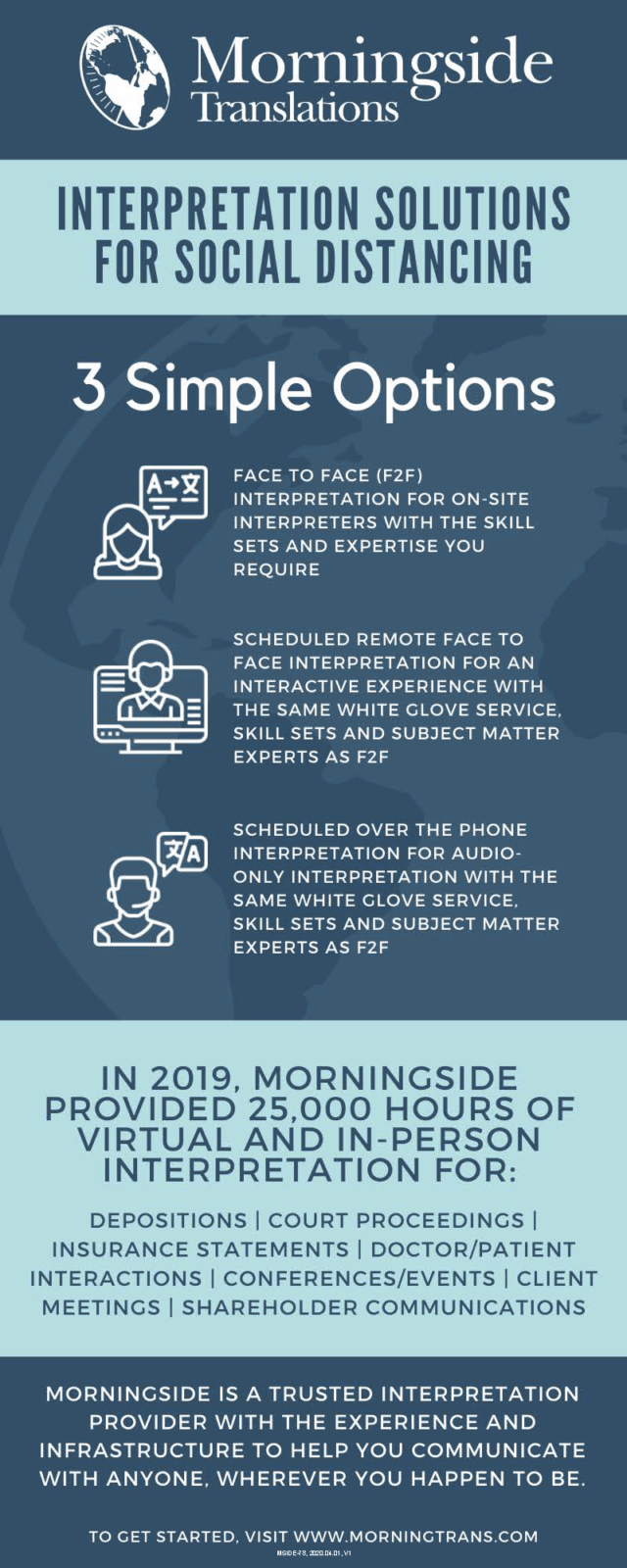
3 Simple Interpretation Solutions for Social Distancing

Over the course of months of worldwide social distancing efforts, inquiries regarding Morningside’s interpretation capabilities have increase dramatically and we’ve seen a shift in the way that clients are utilizing our services. We understand that our clients need greater flexibility during this time, and want to confirm that Morningside’s interpretation capabilities are readily available to you for depositions and court proceedings, as well as mission critical business functions. You can read more about them below.
Get the latest insights delivered to your inbox
The Challenge of Multilingual Documents In E-Discovery

The rapid increase in globalization and international commerce means that more and more disputes are crossing borders and jurisdictions. In a recent survey of multinational corporations, almost 50% experienced an increase in cross-border litigation during the past 2 years. The volume of electronic information has also grown exponentially with more people producing more data – on their computers, the cloud and with mobile devices. Technologies for creating and storing electronic data are evolving quickly, adding to the challenges of e-discovery.
On par with changing technologies, the legal industry and discovery, specifically, have also shifted. Computerized information has created mountains of data for legal teams to sift through during e-discovery. Complicating matters even further, cross-border disputes often involve documents in multiple languages. The need to review, organize and translate these foreign language documents can add significantly to the cost, complexity and lead time for e-discovery projects. English-speaking lawyers can’t even begin to review foreign language discovery documents until they are translated to English – potentially delaying the identification of key trial information. And strict budgets and tight deadlines place additional stress on legal teams already bogged down in the e-document mire. Sound familiar?
If you work at a law firm or as part of a corporate legal team, multilingual documents in e-discovery present unique challenges. The pure volume of documents alone can be overwhelming. This is where a language service provider (LSP) can offer some much-needed relief.
LSPs use specialized tools to cull large data sets into more manageable chunks of case-relevant information. The application of filtering techniques like foreign language keyword searches, for example, can identify and remove irrelevant documents from the data set. Then machine translation (MT) can be used to determine the “gist” of what each document contains, helping determine which ones require more accurate human translation.
Lawyers and firms who use kCura’s Relativity platform to manage their document review process can help streamline the translation of foreign language documents during their case. Language Connect, Morningside’s free Relativity plug-in, expedites the translation of foreign language documents by allowing users to instantly send multilingual files for quotes and language identification directly from their own Relativity environment. After choosing between human, machine or hybrid translation solutions in more than 200 languages, all completed translations are automatically delivered back into the Relativity environment – ensuring seamless delivery.
While the review phase of multilingual e-discovery poses unique challenges, legal teams that rely on Relativity can simplify the process by obtaining translations via the plug-in. It’s a process that not only saves time and money, but also grants peace of mind in a world of ever-increasing e-data.
Get the latest insights delivered to your inbox
EUMDR Update: Prioritizing the Fight Against COVID-19
On April 3rd, the European Commission adopted a proposal to delay the application of the EU MDR by one year, to May 26, 2021 in order to allow “Member States, health institutions and economic operators to prioritize the fight against the coronavirus pandemic.”
What does this mean for global healthcare?
This is a positive outcome for healthcare systems across the EU, as it provides for uninterrupted access to vital life-saving devices.
Vice-President for Promoting our European Way of Life, Margaritis Schinas, said: “Shortages or delays in getting key medical devices certified and on the market are not an option right now. The Commission is therefore taking a pragmatic approach and delaying the entry into application of new EU rules on medical devices, so we can have our medical industries pouring all their energy into what we need them to be doing: helping fight the pandemic.”
Stella Kyriakides, Commissioner for Health and Food Safety, added: “Any potential market disruptions regarding the availability of safe and essential medical devices must and will be avoided.”
What does this mean for manufacturers?
The delay is also a positive outcome for device manufacturers. First, it obviously means more time to become compliant. According to industry polls, around 40% of manufacturers weren’t going to be fully compliant by the May 26 deadline. Now there’s enough time to get processes and documentation in shape, including preparing all required translations.
Second, it means more access to notified bodies. There are only 11 MDR-designated notified bodies today. The extension should allow for more notified bodies and increased overall capacity.
Third, it means that manufacturers are able to prepare multilingual documentation for all of their target markets in the EU. There’s an enormous volume of documentation under the MDR that must be translated into the official language(s) of each country. Many companies were prioritizing languages in order to meet the deadline, but now there’s sufficient time to prepare documentation for all intended EU markets.
Stay current & keep in touch
For a refresher on the complex EU MDR language requirements, take a look at our recent webinar that we co-produced with RAPS.
If you have any questions about translating your documentation or MDR compliance in general, please contact us directly.
Get the latest insights delivered to your inbox
How to Handle Interpretation During COVID-19

Millions of people worldwide have been ordered to stay home to help reduce the transmission of novel coronavirus, and that number is only expected to grow in the coming weeks. In the face of such a profound disruption of business-as-usual, many of us are forced to find new ways to work. Here’s what that means for your multilingual business communications in the legal and medical sectors:
Canceled or delayed court proceedings
A number of judges around the globe are delaying court proceedings until some later date as part of an increasing worldwide effort to prevent the spread of COVID-19. The U.S. Justice Department even asked Congress to take the highly controversial step of granting judges the right to hold defendants indefinitely without trial during emergencies such as the pandemic.
While the DOJ request has been broadly condemned on a bipartisan basis, it nonetheless highlights a real problem: Delaying court proceedings is—at best—a temporary solution. Issues in dire need of resolution, including numerous cases before the U.S. Supreme Court (which now plans to postpone two weeks of oral arguments that had been set to start March 23rd), need to be resolved.
Moving legal & medical interpretation online
For the health of all parties involved and to avoid such problem-causing delays, some court systems, such as Washington D.C.’s Superior Court, are switching to a remote operations setup that relies heavily on online services. Obviously, remote interpretation services will become necessary when multilingual matters are involved.
Though remote online interpretation is still a new idea to some, it’s a tried-and-true system that has matured over time with increasing utilization in various industries. For over a decade, hospitals and other medical facilities have been turning to online video remote & phone interpretation as a more flexible means of serving diverse patient populations and connecting with medical colleagues working in different countries. Remote legal interpretation is also often the most practical solution for attorneys and judges tasked with litigating international disputes.
Enlist an experienced language services provider
Of course, the option to continue using on-site interpreters for open sites and in compliance with local coronavirus safety regulations remains. However, for important legal and medical matters that cannot occur in person, don’t hesitate to contact Morningside to activate your remote business continuity plan.
We have extensive experience arranging highly skilled legal and medical interpreters for these specialized industries. We can provide simultaneous and/or consecutive interpretation in over 150 languages supported via all major online meeting platforms — Zoom, Skype, GoToMeeting, etc. — as well as video and over-the-phone interpretation. These options can be arranged in advance or requested on-demand as your business needs change with new COVID-19 restrictions.
Get the latest insights delivered to your inbox
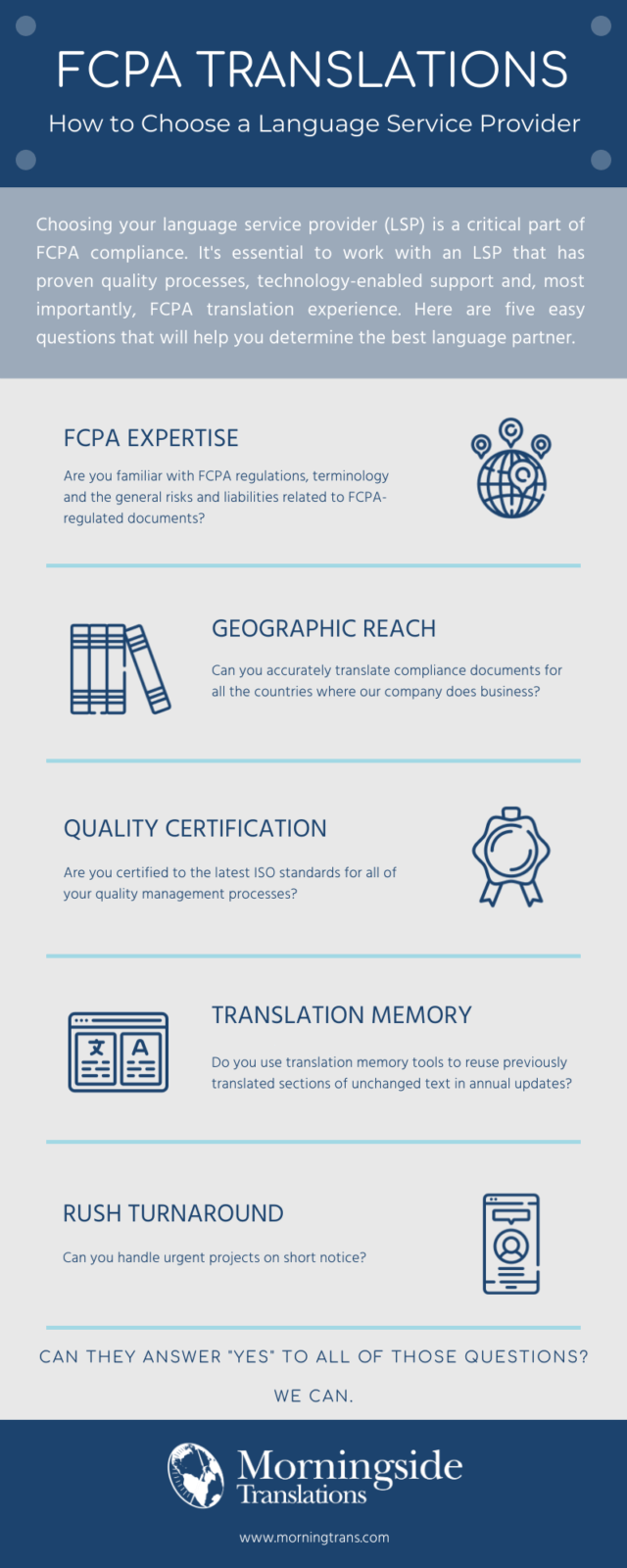
How to Choose a Language Service Provider for FCPA Translations

Get the latest insights delivered to your inbox
How Translation Memory Can Improve Quality While Saving Time & Money

If you’re considering expanding your business into foreign language markets, a translation memory (TM) is one of the tools you can implement with your translation services company. A TM helps translators work more efficiently to reduce costs, increase consistency and reduce time to market. Here’s a closer look at all you need to know about TM.
What is Translation Memory?
A translation memory is a repository of original content and the translated versions of that content. For each new project, the translation services company inputs the new content into the TM, and the TM identifies repeated or similar content. Translators can then reuse previously translated content stored in the TM during future projects. As more content is translated, the TM continues to grow — so the more you put into the TM, the more you get out of it.
How Does a Translation Memory Work?
The TM compares existing content to the new content and identifies three types of segments:
Repetitions/100% match – This type of segment occurs when a new word segment matches exactly with another word segment in the TM. For example, let’s say that you previously translated this sentence: “To complete the installation, you need two AA batteries.” If this sentence exists in a new translation project, it would be identified as a repetition/100% match. The translator still needs to review the sentence for context and quality, but this type of segment takes the least time of the three to translate.
Fuzzy segment – This type of segment occurs when a word segment partially matches another word segment in the TM. Per the previous example, let’s say that your TM contains the following sentence: “To complete the installation, you need two AA batteries.” Now let’s say that your new translation project contains this sentence: “To complete the installation, two AA batteries are required.” In this case, the TM will recognize the sentence as a fuzzy match because the first part matches an existing segment exactly, but the second part is somewhat different. A fuzzy match takes the translator less time to work through than brand new content, but obviously it takes more time than a 100% match.
New segment – A new segment is one that either doesn’t match any existing segments or it matches a segment at less than 50%. A translator will have to translate this segment from scratch.
Note: A translator will see both the original content and the highlighted 100% match/fuzzy/new segments, and then decide whether to accept the translation that’s in the TM or modify it. Upon completion of any translation project, the TM will need to be updated so that it contains the latest information.
Benefits of a Translation Memory
A TM has three main benefits:
It Saves You Money – When repetitions/100% match and fuzzy segments are identified, they will have lower translation fees than new segments. If you’re working in an authoring environment where you have a content reuse strategy, you’ll probably have a lot of 100% match segments. If you don’t have a content reuse strategy, and/or if you have multiple writers, chances are that there will be a lot of fuzzy segments along with some 100% matches. In either case, a TM will make your translation projects more cost-effective due to its ability to recognize word segments.
It Improves Quality – Using a TM will increase consistency across different projects. It makes for a better customer experience when things are translated the same way across all documentation, websites and software applications. Even if more than one translator is working on a project, the suggestions from a TM can help translators remember which specific words to use. This can be especially handy if there are certain standard terms for your industry, product or service. If you work with your translation company to capture this terminology and get it translated before a project begins, you can incorporate it into your TM. A TM and a glossary of standard terms are two good tools to use together for the highest quality translations.
It Decreases Time to Market – A TM prepopulates new content with previously translated segments. A translator can then simply approve those segments and focus their energy on new content. You can really see the benefits of using a TM whenever content is repeated a lot, such as with technical documentation, or with larger projects such as website and software localization. With a TM in place, you can expect faster turnaround time and therefore decreased time to market.
Get the latest insights delivered to your inbox
What is Patent Litigation?

In simple terms, patent litigation is the legal process that unfolds when someone who owns the patent for a particular invention enforces their right by suing another for manufacturing or selling the invention without permission. More often than not, this claim is countered by the accused party who will argue that that particular patent should be deemed invalid.
First-to-File
The first-to-file system is now universal and used in all countries, including the US, which switched to first-to-file when the America Invents Act was signed into law in 2013. That means that even if a person had already developed an idea, unless they have already filed to begin the patenting process, that idea would still be up for ownership.
Patent Litigation – The Long Game
Make no mistake, patent litigation lawsuits are rarely short, easy or inexpensive. That’s because both parties are trying to claim ownership of the same idea or invention and the evidence here is often quite murky. Various patent experts need to be consulted and deposed and the discovery process is complicated and time-consuming. With a lengthy trial comes a hefty price tag and many patent litigation cases will notch up millions of dollars in expenses.
If a claim is being countered, it is the job of the legal team to prove that a patent is invalid. There are many ways to do this, but they all revolve around the idea that an invention lacks originality. If an invention is not far-removed enough from an existing patent, there could well be grounds for making this case.
Settle Up
Once a decision has been made by the courts, the mediation process can begin. In many cases, damages are awarded to the winning party and then the court will mediate between the two.
It’s the aim of the court to get both sides to come to a written agreement. Quite often this will result in the losing party, if countering a claim of copyright infringement, paying royalties to the winning side in order to continue using a patented invention.
Top Notch Support
With the right team behind you, a patent litigation lawsuit can be very profitable indeed. But the process is long and arduous and may end up costing more than the damages you are awarded. A top-notch patent firm will be able to offer you the support you need and provide the necessary expertise to deal with every aspect of your case, but don’t forget it’s a long game, and one that you need the patience and perseverance to play.
Get the latest insights delivered to your inbox
3 Tips to Find Foreign Languages in Your eDiscovery Data

A New Morningside Translations Article Featured on the Relativity Blog.
Relativity is the most popular eDiscovery platform for lawyers and legal professionals. We recently published a blog on Relativity’s website highlighting three important tricks for quickly identifying critical foreign language information. Check it out below.
You are an eDiscovery professional at a big law firm. You sit at your desk, log into Relativity, and sort through documents. You’re cruising right along, finding exactly what you need and even ahead of your deadline. You start to think about lunch. Should I get a $15 salad from the place across the street? Should I get pizza? Get pizza. You deserve it. Get a whole pie. You’re doing great.
Then you come across a huge cache of foreign-looking documents. You think they’re in Romanian, but you don’t actually know Romanian. You also don’t know Latvian, Lithuanian, or Polish. Could it be one of those? A bead of sweat forms on your brow, and you start to panic, running through your options in a mental catalog:
- To ask one of the partners what to do, turn to page 17
- To go down a 13-hour internet rabbit hole, turn to page 25
- To run to the parking lot to cry in your car, turn to page 33
Don’t love those options? Luckily, a few helpful hacks can save you a ton of time and frustration after you stumble upon foreign language documents halfway through your review—or, even better, prevent this heart-sinking moment and find them at the outset.
Identifying foreign languages as early as possible in your review process is critical to achieving clear, predictable costs, preventing unnecessary delays, and constructing a sensible workflow. Here are several easy tricks to help you navigate foreign eDiscovery waters.
1. Use foreign language stop words
If you don’t have Relativity Analytics or are looking for a quick and easy way to scan your data set for a certain foreign language, then a creative use of stop words in a dtSearch might help.
Stop words, called noise words, are the most frequently used words in a given language (for example, in English: and, the, my, all, for). They are typically filtered out of a dtSearch or keyword search, as they tend to be so common that they don’t return valuable search results. However, their frequency also makes them great for finding foreign language documents.
Because it’s safe to assume that stop words can be found in just about any text, a dtSearch for a list of stop words will likely return any documents in the foreign language. If, for example, you believe your data set may contain German, then searching for German stop words will hopefully return any documents with German text.
Note that each language has its unique set of stop words, so rather than translate a list of English words, it’s best to obtain a list of them in the desired foreign language from a legal language services expert.
2. Run language identification
While the stop words hack gets the job done, it requires that you have an idea of which languages are in your data set and proves tedious if you want to search for more than one language. Full language identification analysis is preferable for data sets containing multiple languages or if you simply want to double-check for any foreign languages before proceeding with your review.
Language identification uses machine learning to detect the languages in a piece of text automatically. A feature in Relativity Analytics is that it returns the primary and up to two secondary languages in a document, along with the percentage breakdown of each language.
From here, you can leverage the language identification output to guide your next steps; build dashboards to achieve a birds’ eye overview of the number of documents, custodians, and control numbers by language; batch documents by language so they can be sent to foreign language reviewers efficiently; and then send any documents with foreign language text for machine translation so you can review the gist in English. Regardless of your approach, language identification results lay the groundwork for the rest of your review workflow.
3. Recognize that the internet is your friend—except for when it’s not
The beauty of the internet is that you can find almost anything you’re looking for with the click of a button. A simple Google search of stop words in your suspected language will net you some quick and reliable returns. For example, searching “Spanish stop words” points you to a comprehensive list of stop words in over 40 languages. The internet is pretty great, am I right? But don’t let it give you a false sense of security.
We’re all aware of the free translation tools out there. You might think that simply copying and pasting your documents into one of these free engines might be your ticket out of this language identification mess, but before you go down that road, there are a few important issues to consider:
- Copying and pasting is extremely tedious, considering the volume of documents you’re likely dealing with. “Ctrl+C, Ctrl+V” isn’t really a feasible option when confronted with hundreds or thousands of documents.
- Free online translation tools are not secure. It is also their property once you input text into one of these tools. In most cases, you deal with sensitive documents that shouldn’t be exposed to third parties. But, of course, you already know that.
Choosing one of the hacks above rather than a free online translation tool is a surefire way to keep your data secure and allow your team the time they need to focus on building a killer case.
So you found foreign language documents. Now what?
Now it’s time to determine whether those foreign language documents are relevant, privileged, or something else—in other words, to figure out what they say. You’ll likely want to partner with a trusted language service provider to do that. Choosing a reliable provider is a topic for another day, but here are a few quick tips to get started:
- Ensure they have ISO-certified quality — Bad translations can cause confusion and cost you time and money. Defend yourself against them. Choosing a provider certified by the International Organization for Standardization is a good start.
- Make sure they have extensive experience in eDiscovery — Most often, a combination of tools—such as machine translation, foreign language review, and keyword search term translation—will optimize your time and costs, so make sure your provider is familiar with all of them and how they apply to these types of projects.
- Make sure they are familiar with your chosen technology. Selecting a partner who is already comfortable with your eDiscovery software can save time, boost security, and prevent headaches. Some may even have a dedicated application for your platform, like Morningside’s Relativity plugin, providing dedicated support inside the tool you already know.
With these simple workflow hacks, you have some better options to choose your own eDiscovery translation adventure. Have you used any of them before? Let us know in the comments.

Dylan Blaney, Vice President of Business Development, Morningside, a Questel Company, is responsible for the company's global legal translation strategy and maintaining relationships with the world's largest corporate legal departments and law firms. Dylan expertly advises law firms and corporations on best legal translation practices, specifically implementing workflows and technology that reduce cost, improve quality, and accelerate deadlines. He specifically focuses on international litigation & arbitration, FCPA, patent litigation, M&A, internal corporate communication & documentation to ensure adequate global communication in the legal marketplace.
Get the latest insights delivered to your inbox
Patent Embodiment: Why Multiple Are So Helpful

“Patent embodiment is the description of the production, use, practice, or expression of an invention in the patent application.” according to the UpCounsel. Imagine this: ‘Company A’ owns a patent for an energy-efficient lawnmower. ‘Company B’ starts manufacturing a lawnmower that looks eerily similar. When ‘Company A’ finds out, it sends a cease and desist letter. ‘Company B’ fights back, saying its product is not infringing. They go to court, where a deciding authority — a judge, examiner or board — delves into ‘Company A’s’ patent claims to determine what legally constitutes infringing activity.
The claims’ language is at the core of this decision: If it is solid and transparent, then the semantic investigation will probably work out in favor of ‘Company A,’ the patent owner. If the patent claims are vague, ‘Company B’ could win the case.
How to protect yourself
To avoid being on the losing end of such a judgment, IP applicants should consider listing multiple embodiments on their patent applications. The Oxford Dictionary defines an embodiment as “representing or expressing something in a tangible or visible form.” On a patent application, an embodiment is a detailed description of how an invention can be made or used. It’s not enough to assume that this is obvious or implied – it must be explicitly stated to take advantage of maximum protection.
For example, if there are multiple methods of making an invention or if it is an invention that has (or could have) various uses, the patent applicant should list every possible embodiment they can imagine in the specification. Doing so makes it less likely that an infringer will later be able to exploit vagueness in the issued patent.
Global Patent Filing
Remember Companies A and B above? Now that you understand how critical patent semantics can be, one of the most important steps you can take when filing for protection in multiple countries is to ensure that you have translated every embodiment accurately. You want there to be as little interpretive “wiggle room” as possible should IP litigation occur.
IP litigation can be particularly challenging when a determination is to be made by a judge, examiner or board that is familiar with a different IP system, language and culture from your own. An LSP specializing in international patent filing can ensure that every application you file is translated accurately and appropriately.
Case Study: Purdue vs. Alvogen
In the case Purdue Pharma LP vs. Alvogen Pine Brook LLC, one point of contention clearly illustrates the importance of thoroughly listing multiple embodiments. Here’s what happened:
- Purdue Pharma owned US Patent No. 9,750,703 for “encased tamper-resistant controlled release dosage forms.”
- Purdue Pharma used this technology to create Butrans, a prescription medication used to “treat pain that continues around the clock.” Butrans comes in the form of a patch that contains an extended-release opioid absorbed through the skin over seven days.
- While Butrans was still patent-protected, Alvogen, another life science company, started marketing a generic version of the extended-release pain medication.
- Purdue Pharma claimed Alvogen’s generic version infringed upon Patent No. 9,750,703.
- The case went to the Delaware District Court, where Purdue won.
A closer look at Patent No. 9,750,703
In discussing a time-release shell for a pharmaceutical, the following phrase in Patent No. 9,750,703 became critical to Purdue’s win: “A layer encasing the core and comprising a second portion of hydrocodone bitartrate dispersed in a second matrix material.” At issue was the meaning of “layer encasing the core.” Did the patent refer to, and protect only a single-material layer, as Alvogen asserted? If so, it couldn’t apply to a shell made up of multiple materials, as their product did.
Ultimately, the court concluded after reviewing the following embodiment regarding different ways Purdue’s shell could be constructed: “The shell of the dosage form can be formed, e.g., by compression coating, molding, spraying one or more layers onto the core, dipping one or more layers onto the core or a combination thereof.” The court sided with Purdue and concluded that the term ‘layer encasing the core’ means “one or more materials enclosing a space or surrounding the core.”
The takeaway here is that because Purdue’s application was farsighted enough to include these multiple embodiments — i.e., the various ways in which their shell could be created — they were able to prevail in the infringement suit against Alvogen.
Invaluable patent embodiment: How multiple patent embodiments are especially crucial with global patents
If you plan to protect your patents in multiple countries, the last place you want to find yourself is in a legal dispute in front of a foreign authority who has to read between your lines. Working with an LSP that can anticipate potential local unclarities can, ultimately, make a huge difference. By knowing each region’s IP system, being fluent in the local language, and understanding the cultural lens through which the details in your filing may one day be viewed, the right LSP can help ensure your IP protection is rock-solid uncontestable.
Get the latest insights delivered to your inbox
What’s the Difference? Legal Interpreter v. Legal Translator

Attorneys, courts and case law often conflate the need for legal translators or interpreters. While both types of language professionals carry meaning from one language to another, they do it in different contexts, work with different source materials, and require a somewhat different skill set and even a different personality. When handling international disputes, it’s important to understand the distinction between the two to ensure you get the language support you need. If you ask, “what is the Difference Between a Legal Interpreter and a Legal Translator?” we have summarized what each does and their skillsets below to help.
Legal interpretation
What they do: A legal interpreter works with the spoken word during depositions, in court, over the phone, in video conferences, and interviews. Interpretation can occur simultaneously, as you might see for speakers at United Nations meetings, or consecutively, as you might see in a courtroom where a foreign witness pauses their testimony to allow an interpreter to repeat their words in the local language.
Skillset: An interpreter has to be a quick thinker. He or she needs to be the sort of person comfortable with operating on the spot, in the heat of the moment. The conversion of words from one language to another has to be as close to instantaneous as possible. Therefore, an interpreter must be a strategic thinker who can quickly judge the words that best reflect a deponent’s or an interviewee’s meaning. In addition, the linguist has to be aware of the legal implications of one word choice over another. All of this calculus occurs silently, instantly, and invisibly in the interpreter’s thoughts. It’s a high-wire act requiring a personality unlike an athlete’s or a performer’s.
Legal translation
What they do: A legal translator works with the written word, including contracts, briefs, discovery and other court documents, patents, medical documents, etc. Where an interpreter’s job is about speed, a translator’s work is about depth. He or she has to produce the most accurate rendering possible of a source document in a different language. To do this, translators typically have more time than interpreters, though the time constraints vary case by case.
Skillset: While poring over contracts, patents, discovery documentation, and transcripts, a legal translator must be a person attuned to subtleties everywhere, gleaning meanings hidden in language differences and identifying nuances that have the potential for moving the legal process forward. In a sense, where the interpreter’s personality resembles the acrobat, the translator’s is more that of the persistent, street-wise detective.
Things interpreters and translators have in common
Obviously, both types of linguists require mastery of the languages involved. For interpreters and translators, accuracy is always the number one priority. To achieve this, both types of linguists need extensive knowledge of the relevant cultures involved. There can be conflicting meanings or contextual shadings lurking in what may, on the surface, seem to be the same word in two languages. In legal contexts, these differences can result in profound consequences, and you need to be able to rely on your legal linguist to get it right.
One classic example of translated words gone wrong is the Treaty of Waitangi between Britain and the Maori of New Zealand in 1840. In the Maori translation of the treaty, the British were to provide a turnkey legal system for the Maori’s use in exchange for letting the British use some land; in the English version, England was taking full possession of New Zealand. Over the next few decades, a series of violent disputes – called the New Zealand Land Wars – erupted over land ownership issues.
Another example highlights how even a single mistranslated word can bring down an entire case. In Motion Fitness vs. Changzhou Yingcai Metalwork Fitness Equipment, a 2014 patent infringement dispute that went all the way to the Supreme People’s Court of China, the indefinite article “a” was translated on each instance in the Chinese version of the patent claims to “one” – a specific numerical value. This narrowed the scope of protection in the claims and fatally undermined the plaintiff’s case.
The expert you need
A team effort is always more likely to succeed when each role is assigned to a qualified individual who is personally suited to the work. This is absolutely critical when assembling a legal team to bring a dispute to a favorable conclusion. Morningside’s extensive litigation support services can match your needs to the right type of linguist, providing you with the confidence you need to win your case.