
Category: eLearning & Training
ELearning Training Tips: Multilingual Content Creation

As a global organization, localization of eLearning content is essential for training current and new team members. Of course, it can be challenging to develop multilingual eLearning courses that will successfully communicate to various learners across borders, languages, and cultures.
That means the numerous elements supported in eLearning modules, such as captions, slides, image text, and video, must be thoughtfully delivered to each intended audience without losing any of the original content’s meaning. This often requires careful planning and a significant amount of work.
Localized courses allow for increased comprehension, lower costs, and higher retention. Who you partner with can significantly reduce your workload and costs – and partnering with an experienced language service provider (LSP) means avoiding costly and time-consuming detours and bottlenecks during international eLearning course creation and production.
Should you decide to offer localized multilingual eLearning courses to your global organization, we have created an eBook, “Best Practices for Producing Multilingual eLearning Courses,” available for download. Here are some initial tips you should know, and you can receive our complimentary guide for more.
eLearning Training Tips for Content Creation
When you start working on developing content for your new multilingual eLearning training course, follow these six tips to make future translation attempts easier:
- Don’t use slang or local jargon
- Know your audience and their reading level
- Avoid using passive voice
- Use lists
- Expect expanding text
- Cultural considerations
Working with an LSP
Once you’ve selected a translation company, there are five things you can do to improve accuracy and consistency and simultaneously reduce your costs:
- Create a glossary
- Supply style guides
- Select an in-house liaison
- Simplify graphic design work
- Utilize translation memory
The Final Steps
Once you have completed the production of your translated eLearning course, we recommend implementing the following final checks:
- SCORM testing– Ensures all clicks/touches, transitions, timing, tests, and quizzes work as expected.
- Student sample survey– If time allows, a small group in each target country tests the user experience and comments on the completed course.
A Reliable Solution
Morningside has a rigorous eLearning localization workflow that is thorough and standardized to create accurate, high-quality localized courses. We have over 20 years of experience working with more than 13 authoring tools in many different subject areas. Global 500 companies worldwide trust us to create and deliver their multimedia content in all required formats. Our full suite of services includes graphics, voiceovers, subtitles, and more.
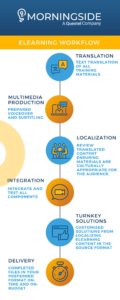
Contact Morningside today to learn how our team of experienced project managers, linguists, voiceover talents and technical experts can ensure that your eLearning courses and modules are analyzed efficiently, translated and localized accurately, and delivered on time and on budget.
About Us
Morningside, a Questel Company, is a recognized leader in eLearning translation, providing a full range of language and multimedia services to help you deliver instruction and content to employees, end users, and customers around the globe. Whether your focus is educating and orienting a global workforce or delivering on-demand research and collaboration, Morningside has the expert knowledge and proven experience to help you make the most of your global learning and training programs. We provide fast turnaround times, unparalleled accuracy and 24-hour customer support, with a proven track record of delivering projects on time and on budget.

Madeline Sturdivant, Brand Marketing Manager at Morningside, a Questel Company, is an accomplished marketing professional with over six years of experience in digital marketing, branding, events, and strategic communications. She leads global marketing strategies, driving brand growth and managing multi-channel campaigns that connect with diverse audiences. Passionate about storytelling, Madeline excels in creating compelling content that resonates with customers and stakeholders. With a proven track record of enhancing brand visibility and fostering engagement, she leverages data-driven insights to craft strategies that exceed business objectives.
Get the latest insights delivered to your inbox
Translation Quality Standards – What Are They?
When beginning the process of partnering with a professional language services provider (LSP), you will hear a lot about the quality of translations provided – at least, you should. This leads to the question of what are translation quality standards.
According to the International Organization for Standardization (ISO), quality can be defined as “the totality of features and characteristics of a product or service that bears its ability to satisfy stated or implied needs.” In the case of translation, quality can be defined as the success of the translation in accurately capturing and conveying the information and intent of the source document.
Translation quality becomes mission-critical in domains such as medical, legal, accounting, technical documentation, and intellectual property (IP). Poor-quality translations could cause a loss of business value and, in some cases, even a loss of life.
What is an ISO Standard?
ISO standards set out various business processes and best practices internationally agreed upon by experts. ISO standards for translation quality focus on establishing and maintaining a process of translation, review and approval that, when followed diligently by qualified professionals, will consistently result in reliable, accurate translations and meet the requirements of the customer’s use case.
Two Examples of ISO Quality Standards
ISO 9001:2015 is the world’s most widely recognized quality management standard. ISO 9001 outlines ways to achieve consistent performance and service at all levels. Achieving this certification means a company has created a quality system with a framework for better customer satisfaction, staff motivation and continuous improvement.
ISO 17100:2015 is an international quality standard set precisely for the translation industry. It defines the requirements for the core processes, resources and other aspects necessary for delivering a quality translation service. Certification to ISO 17100 showcases a translation company’s high level of commitment to meeting client and industry requirements.
Industry-Specific Translation Quality Standards: A Medical Example
Some industries have specific translation quality needs that more generalized quality standards cannot meet. A good example is ISO 13485:2016, which specifies requirements for a quality management system. This standard requires an organization to demonstrate its ability to provide medical devices and related services, such as translation, that consistently meet customer and applicable regulatory requirements to remain compliant.
ISO 13485 can also be used by suppliers or external parties that provide products or services to such organizations. LSPs, like Morningside, certified to ISO 13485, collaborate with medical device companies to determine risk management for all medical device translations. With the LSP implementing processes that reduce the potential for product risks, the medical device company reduces its exposure to compliance and legal issues, not to mention the risk to customers.
International Standard for Security Management
ISO 27001:2013 is an extensive framework of requirements for “establishing, implementing, maintaining and continually improving an information security management system.” It ensures that business information is handled confidentially and securely and that appropriate care is taken to mitigate risks compromising client data integrity.
Morningside is the world’s first significant patent translation and filing company to obtain this certification. We are one of only a handful of LSPs to have achieved it. Achieving this prestigious certification is no small feat and demonstrates a complete commitment to client data, systems, and processes.
It’s all about the people and the process
Translation quality standards play an essential role, but they are no substitute for providing ongoing training and feedback to translators, as well as arming translators and editors with the necessary resources and information on the subject matter, the context in which the translation will be used, etc. Translation teams equipped with glossaries, style guides, support materials, and contextual information can produce a much higher quality translation than those just handed a text with no background.
About Morningside, A Questel Company
Morningside, a Questel Company equips the world’s leading organizations with accurate, high-quality, professional translation services. We specialize in highly regulated industries, including legal, life sciences, corporate compliance and IP. We help your ideas reach new markets and audiences while allowing you to do more with your budget. Our global network of 8,000+ vetted translators includes subject matter experts (SMEs) in various technical fields and practice areas. Morningside is supported by industry-leading technology and a quality management system certified to the latest ISO 9001, 13485 and 17100 standards. We translate complex materials into 200+ languages for Global 500 companies, international law firms, and regulatory bodies.
Madeline Sturdivant, Brand Marketing Manager at Morningside, a Questel Company, is an accomplished marketing professional with over six years of experience in digital marketing, branding, events, and strategic communications. She leads global marketing strategies, driving brand growth and managing multi-channel campaigns that connect with diverse audiences. Passionate about storytelling, Madeline excels in creating compelling content that resonates with customers and stakeholders. With a proven track record of enhancing brand visibility and fostering engagement, she leverages data-driven insights to craft strategies that exceed business objectives.
Get the latest insights delivered to your inbox
Articulate RISE 360 & L10N:
eLearning Content Localization
In our recent blog, “The eLearning Industry & L10N,” we discussed eLearning content localization with key points like using Simplified Technical English and what to consider when selecting your organization’s eLearning platform.
As the title suggests, in this blog, we will review the recommended L10N (localization) process for Articulate RISE 360.
Since its debut in 2016, Articulate RISE 360 (RISE 360) has grown tremendously in popularity. Morningside, as a professional language services provider (LSP), we have seen the requests for RISE 360 localization grow year over year. Just this year, we have already localized over 1000+ modules. That isn’t by accident; there are many benefits that steer organizations toward the platform.
Benefits of Articulate RISE 360
With any platform, there are pros and cons, and RISE 360 has many to consider. To better understand the platform, we should start with getting to know what makes RISE 360 many organizations’ preferred eLearning platform:
Pros:
- It’s a SAS Web tool, so there is no need to install software or worry about disk space
- Cross-platform, it can be used in Windows or on MAC
- The technical writer only needs a web browser and internet connection to get started
- Editor with building objects
- Add external interaction from published Storyline 360 for complex content
- With a subscription to RISE 360, you also get access to all Articulate 360 services
Cons:
- Customization of features in the editor is limited compared to other tools
- No native versioning –the technical writer needs to keep a copy of versions as needed
- An annual subscription is only available per user
Writing your content is the first place to start. Below we have detailed the localization process and how it applies to RISE 360 and its users.
Before Localizing Articulate RISE 360
So, you have written your content with RISE 360, and now a localized version is needed. At Morningside, we recommend that your team begins by performing a source review before starting the localization project.
That means reviewing all of the sources you want to localize to determine the L10N readiness. The essential items you should examine are:
- Make sure the layout formatting and the content are finalized.
- Determine if the media/resources in the module should be part of the localization project.
- Media can include images with text, video and audio clips.
- Resources such as external links and files attached to the modules like PDFs.
- Screenshots – Assess how many are there?
Suppose there are images with text that should be part of the localization process. In that case, it can be simplified if the images containing text are replaced with a similar image without text, and the image text will be written using the RISE 360 editor around the new image.
If this is possible, specialized image handling won’t be needed. If desired, you can request this from an experienced LSP like Morningside to assess and perform for you.
Screenshots should be decided on whether they need to be replaced with a localized version or if the originals should be kept.
As for the video, there are various considerations and options available as part of the localization project:
- Replace with a localized version you already have
- Add subtitles
- Replace the narration with a dubbed version of the audio
- Provide the source files to replace onscreen texts
- And more…
It’s also possible to decide to leave the video as is without modification.
As there is no built-in version-keeping mechanism in RISE 360, if you haven’t already made one, it’s recommended to compile a set of internal rules to keep versions. You can do so by making a copy of modules that are about to go through significant changes, but the versioning is still needed.
Are You Ready to Begin Localizing?
After you have reviewed your finalized modules, there may be some cases; you might consider creating a copy of the finalized source and a new version specific for L10N with revised content like other images, videos, external links and so on.
Remember that you will need to maintain two versions from that point. This solution is not always the best option for all technical writers.
Sending for Localization
There are two standard options to focus on here:
- Send a copy of – Turnkey solution
- Export an XLF – Translation-only option
Send a copy of – Turnkey solution
When selecting this method, your part in the L10N project is only to send Morningside, or your chosen LSP provider, a copy of the RISE 360 module. This is done by choosing the “Send a copy” option in the module three-dot menu.
Your LSP will examine the module content based on your requirements. When partnering with Morningside, we will advise the total cost for localizing the provided module.
At Morningside, we have delivered several thousands of localized RISE 360 modules. As an experienced LSP, we provide a Turnkey solution to our customers weekly.
Export XLF – Translation-only option
If you would like to remain predominantly in control of various project aspects, you can export an XLF file from the module from the settings menu in RISE 360, send the XLF for translation and import the translated XLF.
When choosing this option, it is essential to note that you will be managing the post-translation elements of the module, like layout corrections, image replacements, etc.
After Localizing what you should get from Morningside
Once your RISE 360 L10n project has gone through our robust localization process, including; translation, review, post translation layout editing and LQA.
We will also provide instructions on how to replace the RISE 360 Labels (UI) with the translated languages of the module. Eventually, to the end-user, there will be a completed module that would look as if it was initially written in the target language.
As an experienced LSP, we can provide a turnkey solution or only translations. We review the source module before translation and advise about issues that may help reduce the budget and TAT of the module localization. Using our workflow, our localization engineers can ensure precise, accurate translation, seamless integration, and user-friendly deliverables that provide the same user experience as your source content.
Morningside’s eLearning Workflow is part of the Articulate RISE 360 L10N process.
Summary
At Morningside, a Questel Company, we have delivered thousands of localized RISE 360 courses over the years since this platform was introduced. Our experienced team includes expert linguists, desktop publishing and typesetting specialists, voiceover talent, and project managers experienced in providing multilingual eLearning localization services.
We have subject matter expertise in dozens of fields, including engineering, marketing, finance, and IT. Whether you need to translate a course module or localize a virtual learning environment (VLE), Morningside’s team delivers consistent, high-quality content across many eLearning formats and applications.
When Morningside is requested to provide a turnkey solution, we will take care of all the aspects of the localization project for you and provide a hassle-free product you can provide your employees or clients. We recently partnered with a global 100-footware retail client to discuss their experience with Morningside for Articulate RISE 360 localization. Read the case study, “Renowned footwear retailer partners with Morningside for our RISE eLearning authoring, translation and localization expertise.”
About Morningside
Morningside, a Questel Company, is a recognized leader in eLearning translation, providing a full range of language and multimedia services to help you deliver instruction and content to employees, end users, and customers around the globe.
Our complete multimedia services include desktop publishing (DTP), voiceovers, subtitling, and more. We provide a one-stop solution for your multimedia localization project, from transcription & translation to testing & QA. Whatever the complexity of your project, we offer customized solutions that meet your budget and deliver the completed project on time and in any format you require.
Whether your focus is educating and orienting a global workforce or delivering on-demand research and collaboration, Morningside has the expert knowledge and proven experience to help you make the most of your global learning and training programs. We provide fast turnaround times, unparalleled accuracy and 24-hour customer support, with a proven track record of delivering projects on time and budget.

Ehud Ganor, Senior Localization Engineer for Morningside, a Questel Company, has worked for Morningside as a localization engineer for four years and in software programming and localization for 22 years. He is an experienced Localization Engineer with a demonstrated history of working in the translation and localization industry. Projects involving – Multilingual, Online Help, SDL tools, Linguistics, and Internationalization. Software Programming focused on C++ (ATL/ActiveX). Software Programming (Practical Engineer) from Hadassah College Jerusalem.
Get the latest insights delivered to your inbox
Producing Multilingual eLearning Courses: Morningside Best Practices eBook Available

Multilingual eLearning is the way of the future for businesses and educational institutions alike. It has proven to be highly effective for training employees or users over the past few decades, and that trend is only going to rise. The major setback? It takes hours upon hours to develop thoughtfully delivered eLearning modules. Delivering the same content with the exact user experience in multiple languages is a challenge, but it’s required to successfully communicate with teams around the globe, some with their own set of cultural nuances.
Multilingual eLearning training is essential for providing the necessary support to users who speak a different language. eLearning, of course, is more convenient, effective, and efficient than a traditional classroom – and localized content allows for improved comprehension and higher retention. But, in order to take advantage of this effective training tool, you need to ensure the courses you’ve created resonate with your audience.
So now that you have developed your course, you might be wondering: “how do I localize my eLearning course to increase support for global employees or users?” That’s why we are pleased to offer our new eBook, “Best Practices for Producing Multilingual eLearning Courses.”
In this eBook we look at:
- Frequently used eLearning Software Platforms
- Best Practices for Preparing your Project
- Multimedia Requirements
- Morningside’s Localization Process
It is time to understand how localizing multilingual eLearning for a global audience can help your business pivot for remote employees, including online educational institutions and the many industries seeing a boom in hiring and onboarding employees.
Morningside has a rigorous six-tier eLearning localization workflow that is thorough and standardized to create accurate, high-quality localized courses. We have over 20 years of experience working with more than 13 authoring tools in many different subject areas. Global 500 companies worldwide trust us to create and deliver their multimedia content in all required formats. Our full suite of services includes graphics, voiceovers, subtitles, and more.
Download our eBook, for access to our Best Practices and reach out to Morningside with your next multilingual eLearning project.
About Us
Morningside equips the world’s leading corporations with a full suite of end-to-end translation and localization solutions for their corporate compliance needs. Our language services ensure your ideas and policies are seamlessly communicated to your employees, partners, and customers and meet all local and cultural requirements.
Madeline Sturdivant, Brand Marketing Manager at Morningside, a Questel Company, is an accomplished marketing professional with over six years of experience in digital marketing, branding, events, and strategic communications. She leads global marketing strategies, driving brand growth and managing multi-channel campaigns that connect with diverse audiences. Passionate about storytelling, Madeline excels in creating compelling content that resonates with customers and stakeholders. With a proven track record of enhancing brand visibility and fostering engagement, she leverages data-driven insights to craft strategies that exceed business objectives.
Get the latest insights delivered to your inbox
Starting a New Multilingual e-Learning Course

E-learning has quickly become ubiquitous in our digital world. It can be the most effective way to train your own company or your users, allowing for interactivity and customizations to your needs. You can spend hours and hours developing and fine-tuning your e-learning courses, so they are just right. But what happens if you need that e-learning course in other languages?
Multilingual Training
It is important to support employees or users who speak different languages to increase market share or keep your international team. But now that you’ve developed a complex training course, how do you start to get it localized into other languages? It can certainly seem to be a daunting task.
Authoring Software
A lot depends on the type of e-learning software you’ve chosen. Most of the big names in e-learning (i.e., Articulate, Captivate) have built-in multilingual support, making it much easier to localize your courses. They have accessible export/import features to send your content for translation then pull it back in when it’s done. They also usually have built-in translations for the common labels and buttons.
Other e-learning tools that may be newer or more limited in terms of market share might have similar support, or it might take more effort to do the localization. Then there are those who have made homegrown e-learning courses from scratch. Those can be localized as well but may take more custom processes. Regardless of the tool you choose, there is almost always a way to localize your courses.
Multimedia Usage
The other consideration is your multimedia usage within the course itself. Do you have images with text in them? Screenshots of your software? Videos with onscreen text or voiceovers? You can decide which of these things need to be localized and should stay in English. There are also various options for localizing the videos, ranging from the more expensive (creating timed voiceovers in each language) to the more cost-effective (adding localized subtitles). Whatever your multimedia requirements are, be sure to communicate that upfront to your language solutions provider.
Quality Assurance
One thing that is critical to any e-learning translation is a Linguistic Quality Assurance (LQA) step of the fully localized course. After all, the translated pieces are put together – text, images, videos, button labels, etc. – it’s important that a native speaker review the full course to make sure everything is localized and looks correct in context. It’s this step that can identify any final issues before your end-user sees the course, helping to make sure everything looks perfect.
The Morningside Solution
Morningside is completely capable of taking on all this work for you, offering a turnkey solution to your e-learning localization needs. Please send us your e-learning course, let us know what your multimedia requirements are, and allow us to prepare and deliver a fully localized e-learning course in any language. This will save you the hassle of doing the work yourself, and you can rest easy knowing that language experts are handling all the intricacies of localization for you.
Keep an eye out for the updated version of our Multilingual E-Learning Guide, which will be out soon! And please don’t hesitate to contact us for any translation or localization needs!

Jennifer Schudel, Associate Director, Localization Engineering, Morningside, a Questel Company, a subject matter expert & Localization Engineer, having 12 years of experience in translation and localization for Flare projects, software and websites. She has previously partnered with MadCap Flare associates in webinars and presented at MadWorld.
Get the latest insights delivered to your inbox
What to Know About Text Expansion and Contraction
You may have noticed that it can take more words to say something in one language than in another. For example, it takes three words in French (s’il vous plaît) to accomplish what you can with one word of English (please). Text expansion and contraction has a direct impact on the cost of translation, and it plays an extremely important role when considering design for multilingual websites, marketing campaigns, presentations – and pretty much any project that needs to be available in multiple languages.
What is text expansion and contraction?
This is a term used in the translation industry to account for the increase or decrease in a document’s final word count when it is translated. For example, French and other romance languages are known to be wordier than English. A document with 1,000 English words translated into French will convert into approximately 1,150 target words — a 15% increase in the document’s word count. That is text expansion. Asian languages like Chinese, Korean and Japanese will usually convert into fewer total words when translated into English. That is text contraction.
How does text expansion and contraction affect pricing?
Calculating expansion or contraction during translation is not an exact science. Most language service providers use ratios based on typical expansion/contraction rates for different language pairs. For example, in English to German translation, the word count usually contracts by 20%, and therefore this is the ratio that most translation companies use. (If you have ever seen a German compound word like Donaudampfschifffahrtsgesellschaftskapitänsmütze – which translates to “Danube steamboat shipping company Captain’s hat” – you’ll understand why.) Pricing can also be affected by a document’s subject matter, terminology, and the quality of the original writing — all of which can cause the text to expand more or less than the ratios predict.
How does text expansion and contraction affect design?
Let’s say you have a short product description in English (100 words) that needs to be translated into French for a PDF brochure, a video advertisement, and a software app. Here’s what could happen: A one-line English headline in a cleanly laid out PDF brochure can turn into a two-line French headline that bumps the rest of the copy down or even off the page. A video with music and graphics synced to English text can become unsynced when the text is translated to French. The menu buttons on a software app can end up expanding awkwardly or displaying incomplete words, causing a major UI problem. So, as you can see, translations that result in text expansion or contraction can have a very real impact on design quality. That’s why it’s important to work with a localization expert to ensure all of your materials are not only translated accurately, but visually adapted as well.
Trust a localization expert
Morningside has 20 years of experience working with businesses to linguistically adapt products, documents, websites and software applications for target markets around the world. It’s a process we call localization, where translation is just the first step. We then work to adapt layout, design and graphical elements to properly fit the translated text. Our team includes expert linguists, DTP specialists, voiceover talent, and dedicated project managers experienced in providing multilingual localization services in 200+ languages. If you have any more questions about text expansion and contraction, or localization in general, contact us below.
Madeline Sturdivant, Brand Marketing Manager at Morningside, a Questel Company, is an accomplished marketing professional with over six years of experience in digital marketing, branding, events, and strategic communications. She leads global marketing strategies, driving brand growth and managing multi-channel campaigns that connect with diverse audiences. Passionate about storytelling, Madeline excels in creating compelling content that resonates with customers and stakeholders. With a proven track record of enhancing brand visibility and fostering engagement, she leverages data-driven insights to craft strategies that exceed business objectives.
Get the latest insights delivered to your inbox
3 Tips to Help Keep Remote Employees Engaged and Motivated during COVID-19

For multinational organizations that have switched to a remote work setup (like Morningside), maintaining an off-site international workforce raises new management and HR challenges – with communication chief among them. As companies reinvent their way of doing business during the COVID-19 pandemic, it is critical to maintain engagement with home-based personnel. Here are three things you can do to ensure your remote employees feel connected and motivated during these trying times:
Provide interpretation support for online phone calls and video meetings
While it is unsafe to hold in-person meetings, business can run as usual with the use of online phone calls and video meetings. Platforms like Skype, GoToMeeting and Zoom (just to name a few) will support phone or video meetings with colleagues or clients based anywhere in the world – as long as they have an internet connection and no language barriers.
When you’re conducting online business meetings with multilingual participants, it’s important to ensure everyone can understand one another. If there is any risk of a communication barrier, a professional interpreter can make all the difference in the world. During COVID-19, you can rely on Morningside for video remote or phone interpretation services across a wide variety of industries. Our global network of 8,000+ linguists are experts in dozens of technical fields and subject areas, including legal, finance, life sciences, manufacturing, and consumer products, and our quality management system is ISO-9001, ISO-13485, & ISO-17100 certified.
Provide multilingual eLearning courses for employee onboarding & continuing professional development
With personnel working off-site, a genuine opportunity arises to connect with your employees by reinforcing and enhancing critical skill sets via online training and targeted eLearning assignments. Doing so will increase employee engagement, whether it’s for onboarding new team members or providing new learning opportunities for existing employees. Luckily, Morningside is an expert at helping companies develop and deliver successful multilingual eLearning courses for transnational workforces.
Note: There are two ways to provide eLearning modules – live courses or self-guided programs. When companies prepare self-guided eLearning models — which can include everything from PowerPoint presentations and audio scripts to video content and captioned graphics — Morningside will work tirelessly to ensure accurate translation and localization, seamless integration, and user-friendly deliverables that provide the same user experience as the source content. For live sessions, our simultaneous interpreters help present information and graphics clearly and accurately. Audience questions receive the same treatment, allowing for a lively back-and-forth that helps keep employees engaged.
Encourage virtual team coffee breaks or water cooler chats
Social distancing is necessary, but that doesn’t mean we should completely change our ways. Chatting over a cup of coffee or by the water cooler can play an important role in your employees’ happiness and satisfaction at work. So while we can’t take physical breaks together, employers should encourage virtual team breaks where groups gather on Skype, Zoom, or GoToMeeting just to talk. Breaks should be scheduled and timed, but obviously no agendas need to be planned. This is a time for people who are used to spending so much time working right next to each other to catch up and chat in a stress-free environment.
An opportunity not to be missed
Interestingly, recent research reports that people who work at home have been found to be more productive than those operating in a conventional office environment — and that remote workers even put in extra time (the equivalent of 1.4 extra, unpaid workdays each month, or 16.8 days per year). With that in mind, employers can choose to look on the positive side during these restrictive times, and focus on the value that increased multilingual support will bring to employees and clients around the world. For more information on Morningside’s remote interpretation or multilingual eLearning services, please contact us.
Get the latest insights delivered to your inbox
How To Grow Your Business in Multiple Markets

Few companies hit the ground running with a global marketing strategy in place. Usually the process of going international is incremental, a gradual entry into new markets and regions driven by overseas opportunities and new partnerships, rather than a strategic international marketing plan. But even without a formal plan, you can enjoy immediate benefits by translating your website and collateral into several key languages.
Focus on the languages of those countries where you currently do business or are trying to do business. The potential ROI from providing a more customized customer experience far outweighs the actual costs of localization, and this is where you come into the picture: by advocating the global localization of a company’s collateral, a marketing department can make a profound contribution to the bottom line. Here’s how to get started:
Website localization
The research into online buying behaviors tells a compelling story. A Common Sense Advisory survey of 3,000 consumers in 10 non-Anglophone countries found that 75% prefer to buy products in their native language and 60% rarely or never buy from English-language websites. In China alone, 95% of online business is conducted on Chinese-language websites, according to Forrester Research, yet the online presence of U.S. companies in China is almost entirely (99%) English-only. That’s just one example of a massive missed opportunity!
Pro Tip: If your business website is currently in English-only and you want to expand your business in non-Anglophone countries, at the very least you should translate your website into the local language of every country where you currently have customers. You can also go a step further by adapting your content (including colors and imagery) to appeal to local tastes and attitudes. This is called transcreation.
Multilingual SEO
To remain competitive, your company and products should be optimized for search engine exposure in each of the markets you serve. In China, for example, over 70% of the population uses a search engine called Baidu – while less than 2% use Google. In Russia, over half the population uses a search engine called Yandex. If you’re trying to expand into those or other countries, you need to make sure customers there can find you online, regardless of the language in which they search. This requires consistent and accurate keyword translations as part of a multilingual approach to search engine optimization (SEO).
Pro Tip: Proper keyword targeting is just as critical to achieving high search engine rankings overseas as it is in the United States!
Localized marketing collateral
Your message and brand can easily get lost in translation if your marketing and advertising collateral isn’t localized correctly. This can have a direct impact on your team’s bottom line. Working with an experienced language solutions provider (LSP) can help you accurately and skillfully communicate with your target markets and achieve strong results like:
- more effective email blasts to potential customers in different countries
- more persuasive sales presentations with localized slides, displays, banners, brochures, and scripts optimized for different audiences
- more lead generation through subtitled or dubbed video outreach
- increased impact from local-language print ads.
Pro Tip: We recommend staying in touch with customers via company newsletters that help generate excitement about your product and keep you on your customer’s radar. Whether you include product updates, company news or previews of what’s coming next, creating localized versions of these publications in your key markets is a great way to connect and show that you are focused and invested in that country/region.
Multilingual eLearning
If your product requires a demo, you should consider the added value of localized online eLearning modules. Localized training modules can help you to ensure your product is promoted in its best light by every sales rep every time.
Embrace the opportunity
Conquering foreign markets is a prodigious task, but you don’t need to make huge investments in time or money to achieve new opportunities and revenue right away. Translating and localizing your existing collateral is a relatively inexpensive way to reach new customers and, over time, the successful execution of a marketing localization strategy can position your company for dramatic growth in markets around the world. Consider the possibilities.
Get the latest insights delivered to your inbox
How Translation Memory Can Improve Quality While Saving Time & Money

If you’re considering expanding your business into foreign language markets, a translation memory (TM) is one of the tools you can implement with your translation services company. A TM helps translators work more efficiently to reduce costs, increase consistency and reduce time to market. Here’s a closer look at all you need to know about TM.
What is Translation Memory?
A translation memory is a repository of original content and the translated versions of that content. For each new project, the translation services company inputs the new content into the TM, and the TM identifies repeated or similar content. Translators can then reuse previously translated content stored in the TM during future projects. As more content is translated, the TM continues to grow — so the more you put into the TM, the more you get out of it.
How Does a Translation Memory Work?
The TM compares existing content to the new content and identifies three types of segments:
Repetitions/100% match – This type of segment occurs when a new word segment matches exactly with another word segment in the TM. For example, let’s say that you previously translated this sentence: “To complete the installation, you need two AA batteries.” If this sentence exists in a new translation project, it would be identified as a repetition/100% match. The translator still needs to review the sentence for context and quality, but this type of segment takes the least time of the three to translate.
Fuzzy segment – This type of segment occurs when a word segment partially matches another word segment in the TM. Per the previous example, let’s say that your TM contains the following sentence: “To complete the installation, you need two AA batteries.” Now let’s say that your new translation project contains this sentence: “To complete the installation, two AA batteries are required.” In this case, the TM will recognize the sentence as a fuzzy match because the first part matches an existing segment exactly, but the second part is somewhat different. A fuzzy match takes the translator less time to work through than brand new content, but obviously it takes more time than a 100% match.
New segment – A new segment is one that either doesn’t match any existing segments or it matches a segment at less than 50%. A translator will have to translate this segment from scratch.
Note: A translator will see both the original content and the highlighted 100% match/fuzzy/new segments, and then decide whether to accept the translation that’s in the TM or modify it. Upon completion of any translation project, the TM will need to be updated so that it contains the latest information.
Benefits of a Translation Memory
A TM has three main benefits:
It Saves You Money – When repetitions/100% match and fuzzy segments are identified, they will have lower translation fees than new segments. If you’re working in an authoring environment where you have a content reuse strategy, you’ll probably have a lot of 100% match segments. If you don’t have a content reuse strategy, and/or if you have multiple writers, chances are that there will be a lot of fuzzy segments along with some 100% matches. In either case, a TM will make your translation projects more cost-effective due to its ability to recognize word segments.
It Improves Quality – Using a TM will increase consistency across different projects. It makes for a better customer experience when things are translated the same way across all documentation, websites and software applications. Even if more than one translator is working on a project, the suggestions from a TM can help translators remember which specific words to use. This can be especially handy if there are certain standard terms for your industry, product or service. If you work with your translation company to capture this terminology and get it translated before a project begins, you can incorporate it into your TM. A TM and a glossary of standard terms are two good tools to use together for the highest quality translations.
It Decreases Time to Market – A TM prepopulates new content with previously translated segments. A translator can then simply approve those segments and focus their energy on new content. You can really see the benefits of using a TM whenever content is repeated a lot, such as with technical documentation, or with larger projects such as website and software localization. With a TM in place, you can expect faster turnaround time and therefore decreased time to market.
Get the latest insights delivered to your inbox
How to Optimize eLearning for Translation

In a global business environment, the localization of eLearning tools is essential for training new team members and future professionals. However, developing eLearning courses that successfully communicate to many learners across miles, languages, and cultures can seem daunting.
Captions, slides, image text, scripts, audio narration, subtitles, quizzes, example images, and videos must all be thoughtfully delivered for each target audience without losing any of the original content’s subtleties. This requires care, thoughtful planning, and a lot of work.
Partnering with an experienced language service provider (LSP) is a solution that can reduce your workload and costs – if you take advantage of everything an LSP offers. With that in mind, we created this list of best practices you can implement to avoid costly and time-consuming detours and bottlenecks during international eLearning course production.
Content creation
As you develop the content for your eLearning course, keep the following six tips in mind:
1. Don’t use slang or local jargon – Consider where your content will be consumed. Avoid colloquialisms, slang, acronyms, abbreviations, jargon, and metaphors that may have little meaning in another culture.
2. Know your audience and their reading level—To help keep your content as understandable as possible, consider assessing it via the Flesch-Kincaid Grade Level test. This popular readability test identifies the education level necessary for a reader to easily comprehend a piece of text (e.g., a text score of 6 would require a grade 6 education).
3. Avoid using passive voice – This is where the object of an action becomes the subject of a sentence (e.g., Why was the road crossed by the chicken?). Writing in the passive voice can lead to torturous sentence construction and a lack of clarity in English. This can become a critical problem when passive text needs to be translated into other languages.
4. Use lists—People learn differently, and lists achieve several goals. They’re visually memorable, allow learners to grasp ideas in smaller units, and help translators cleanly separate key ideas.
5. Expect expanding text – What can be said in just a few words in one language may require many more in another. Choose visual layouts that can be easily modified for lengthier text translations.
6. Cultural considerations – Striking an effective balance between being interesting, casual and clear is always a concern when preparing eLearning content for consumption in different countries or regions that all carry their own political and cultural contexts. If you plan to use examples in your lessons, ensure they apply to your audience. If not, you risk alienating them or forcing a translator to re-write the passage (e.g., a baseball analogy may not work well outside the United States). Simultaneously, you must consider your tone and imagery choices – not all cultures perceive familiarity or fashion similarly.
Working with an LSP
Once you’ve selected a translation company, there are a few things you can do to improve accuracy and consistency and simultaneously reduce your costs:
1. Create a glossary – To ensure consistency and accuracy in every language, you can supply a glossary of important words, phrases, product and object names, and concepts.
2. Supply style guides—Submit a style guide to codify how you want your written content visually formatted. This will ensure that lessons look the way you want them to in every language.
3. Select an in-house liaison – For anything that must be decided quickly as work progresses, establish an internal subject matter expert (SME) at your company to act as a readily available resource.
4. Simplify graphic design work—If English screenshots need to be localized, consider providing versions of the captures in each target language. If this isn’t practical, offer the LSP access to any software required to recreate the onscreen scenarios. This helps avoid time-consuming recreation of the images using photo-processing tools or including them only in English.
5. Utilize translation memory—Streamline the production workflow by sharing past translations of similar content that can be repurposed or used as reference materials.
The final steps
Once you have completed the production of your translated eLearning course, we recommend implementing the following final checks:
1. SCORM testing – Once a lesson can be output as a SCORM module, test it thoroughly before publishing. Ensure all clicks/touches, transitions, timing, tests, and quizzes work as expected.
2. Student sample survey—If time allows, invite a small group in each target country to experience and comment on the completed course. This can provide invaluable feedback that maximizes the effectiveness of your courses and strengthens their impact.
A reliable solution
Contact Morningside today to learn how our team of experienced project managers, linguists, voiceover talents and technical experts can ensure that your eLearning courses and modules are analyzed efficiently, translated and localized accurately, and delivered on time and on budget.